Assumptions

Chemistry calculator
Use the PH Calculator to find pH, pOH, hydronium concentration, hydroxide concentration, buffer pH, and Ka/pKa values with clear chemistry formulas and fast results.
Enter your values and click Calculate to see the result.
Primary Result
The breakdown shows the exact formula path used for the selected chemistry mode.
This calculator is designed for common aqueous chemistry problems. Results depend on your inputs and do not replace lab measurements, instructor guidance, or more advanced equilibrium modeling.
Calculator overview
Use this pH calculator to convert between pH, pOH, hydrogen ion concentration, hydroxide ion concentration, Ka, pKa, and buffer values. It helps chemistry students check acid-base work with formulas and readable steps.
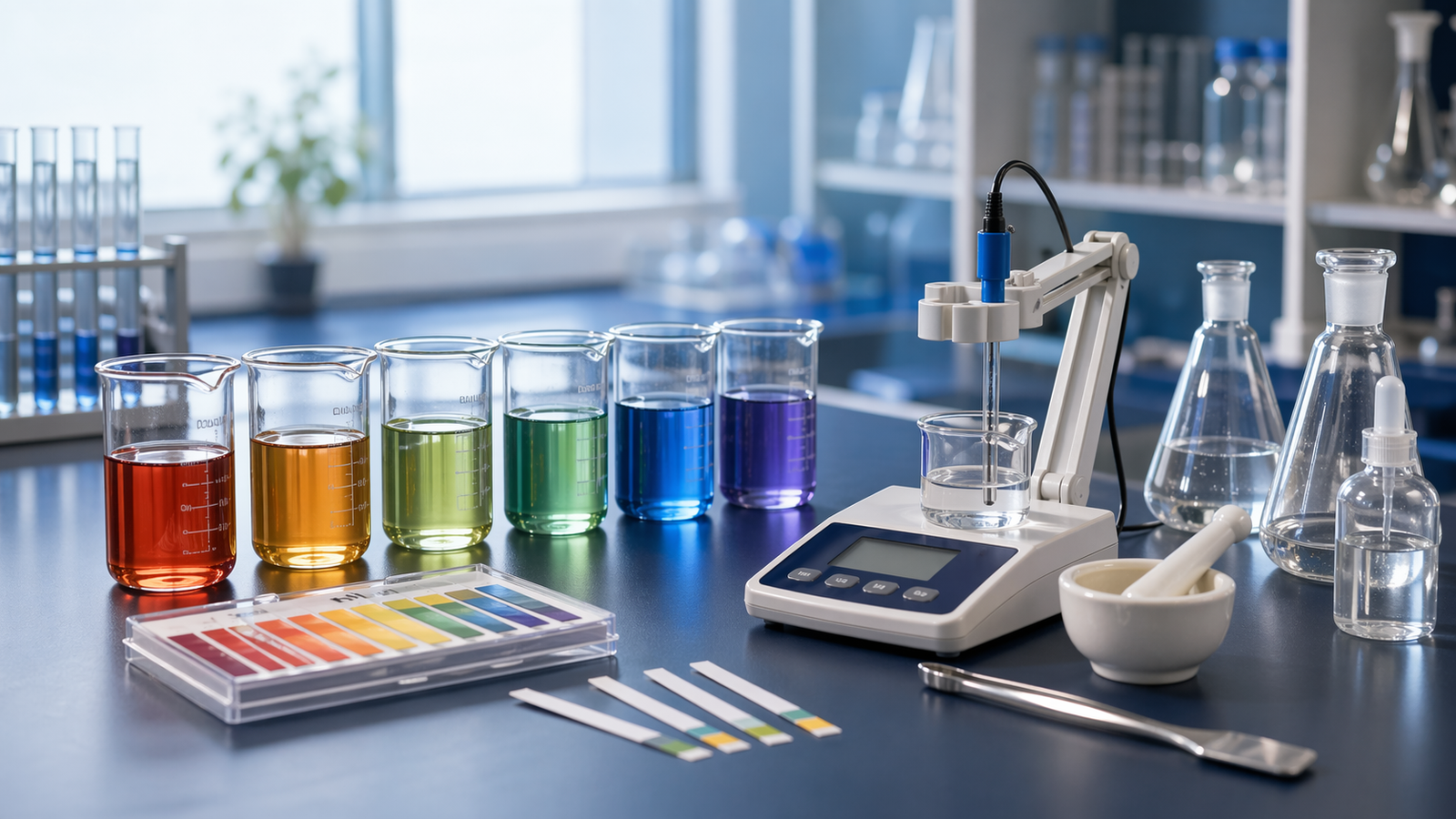
Choose the acid-base mode, enter the known value, and use the result to compare pH, pOH, concentration, or buffer behavior.
Guide
This guide keeps the chemistry behind the calculator compact and readable, so you can move from formulas to a usable pH result without turning the page into a full textbook chapter.
This pH calculator handles the common chemistry workflows most students and practical users actually need: basic pH and pOH conversions, strong acid and strong base estimates, weak acid and weak base equilibrium, buffer pH with the Henderson-Hasselbalch equation, and Ka or pKa style constant conversions.
The page is built to stay general without becoming bloated. That means it can help with quick concentration conversions, HCl-style pH questions, weak-acid homework, buffer solution estimates, and Ka to pKa problems, while still being honest about what is assumed and what is only approximate.
The basic acid-base relationships are logarithmic. They connect hydronium concentration, hydroxide concentration, pH, and pOH for aqueous solutions at 25 C.
pH = -log10([H3O+]) pOH = -log10([OH-]) pH + pOH = 14.00 If you know one of these values, the calculator can find the others directly. Concentration inputs must be positive, while pH and pOH themselves can fall outside the 0 to 14 classroom range when the math supports it.
Buffer mode uses the Henderson-Hasselbalch equation to estimate pH from the ratio of conjugate base to weak acid. It is a practical approximation, not a full equilibrium simulation.
pH = pKa + log10([A-] / [HA]) [A-] / [HA] = 10^(pH - pKa) This works best when both the weak acid and conjugate base are present in meaningful amounts and the solution behaves like a true buffer. That is why the result panel clearly labels buffer mode as a Henderson-Hasselbalch estimate.
Select the mode that matches the problem: basic conversion, strong acid/base, weak acid/base, buffer, or constant conversion.
The form shows the relevant fields automatically so you do not have to guess which inputs belong together.
The result appears only after calculation, with pH-focused outputs, supporting chemistry values, and a short formula breakdown.
Check whether the result assumes complete dissociation, the Henderson-Hasselbalch approximation, or a common monoprotic equilibrium.
Reset clears the form and hides the result so you can start a new chemistry question cleanly.
These two quick examples show how the calculator moves from a common strong-acid problem to a buffer estimate without changing the page structure.
Strong acid example
pH 2 A 0.010 M monoprotic strong acid gives [H3O+] = 0.010 M, so the pH is 2.00.Buffer example
pH 4.9361 With a base-to-acid ratio of 1.5:1, the Henderson-Hasselbalch estimate places the buffer near pH 4.94.Pick strong acid or strong base when the chemistry problem treats the solute as fully dissociated in water, such as HCl or NaOH.
Choose weak acid or weak base when you are given concentration together with Ka, pKa, Kb, or pKb and need an equilibrium-based estimate.
Choose buffer mode when both a weak acid and its conjugate base are present and the Henderson-Hasselbalch relationship fits the problem.
The pH + pOH = 14.00 relationship used here is the standard classroom and lab approximation for water at 25 C.
That is appropriate for common strong acids and bases, but not for weak species that only partially ionize.
The calculator solves the exact quadratic for simple weak-acid and weak-base equilibria without trying to model full polyprotic systems.
Henderson-Hasselbalch is very practical, but it is still an approximation rather than a full activity-corrected equilibrium model.
You can enter values like 1e-7 for concentrations and equilibrium constants when the numbers are very small.
FAQ
Quick answers about pH formulas, pOH, HCl, buffers, Ka or pKa conversions, and chemistry approximations.
The core formula is pH = -log10([H3O+]). In water at 25 C, pOH = -log10([OH-]) and pH + pOH = 14.00.
pH measures hydronium concentration and pOH measures hydroxide concentration. At 25 C, they add up to 14.00, so knowing one lets you calculate the other.
In strong-acid mode, HCl is treated as fully dissociated, so hydronium concentration equals the acid molarity for a monoprotic solution. The calculator then applies pH = -log10([H3O+]).
The Henderson-Hasselbalch equation is pH = pKa + log10([A-] / [HA]). It is used to estimate the pH of a buffer from the ratio of conjugate base to weak acid.
Yes. The Ka / pKa / Kb / pKb mode converts Ka to pKa, pKa to Ka, Kb to pKb, and pKb to Kb using the standard logarithmic relationships.
Yes. Buffer mode estimates pH from pKa and the base-to-acid ratio, or solves the ratio needed for a target pH using the Henderson-Hasselbalch approximation.
Buffer mode uses the Henderson-Hasselbalch approximation and strong-acid or strong-base mode assumes complete dissociation. Weak acid and weak base mode is limited to common monoprotic equilibria.
Search MultiCalculators
Search calculators, categories, and helpful site pages.
Popular calculators and categories
No matching calculators found. Try a broader term or browse by category.