
Geometry calculator
Pool Volume Calculator
Calculate pool gallons, water capacity, average depth, hot tub volume, and pool fill time for round, oval, rectangular, above-ground, and inground pools.
Result
Pool volume results
Your pool volume will appear here
Enter your dimensions and click Calculate.
Total gallons
Liters
Cubic feet
Cubic meters
Average depth
Shape details
- Shape
- Surface area
- Formula
Pool capacity is an estimate based on measured dimensions and water depth. Product labels, rounded wall sizes, plumbing, steps, coves, and actual fill level can change real water volume.
Calculator overview
Quick Pool Volume Calculator Overview
Use this pool volume calculator to estimate gallons or liters from pool shape, length, width, diameter, and average depth. It helps calculate water volume before chemical dosing, filling, or equipment planning.
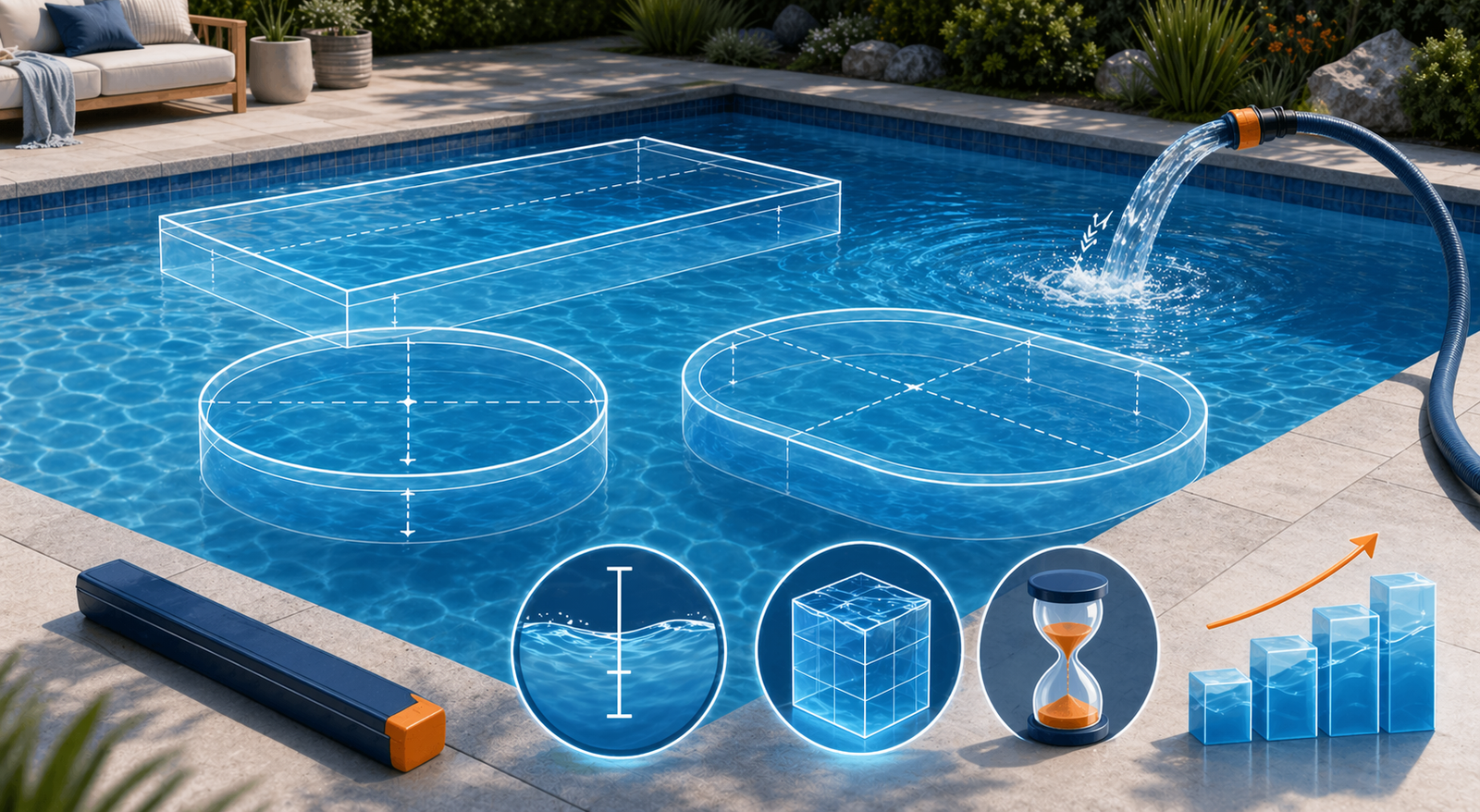
Enter pool shape and water dimensions to estimate volume in gallons or liters.
Guide
Pool Volume Calculator Guide
Use this guide to estimate pool gallons, compare water capacity units, find average depth, and understand how fill-time estimates are built from water volume and flow rate.
What This Calculator Does
This pool volume calculator estimates the amount of water in a swimming pool, spa, or hot tub from the shape, dimensions, and water depth you enter. It supports rectangular, round, oval, and hot tub shapes, with gallons shown first because most pool setup, pump, and maintenance tasks start with gallons.
The calculator also includes a pool fill calculator. Once you know the gallons needed, you can enter a hose flow rate to estimate how long filling the pool may take.
Estimate note
Real pool capacity can differ from a simple geometry estimate because steps, coves, liners, rounded walls, plumbing, and actual fill level all change usable water volume.
Pool Gallons, Water Capacity, and Fill-Time Estimates
If you are searching for a pool gallons calculator, pool water capacity calculator, or pool fill calculator, this tool uses the same volume result in different ways. Gallons help with chemicals and equipment planning, while fill time uses gallons and hose flow rate.
Above-ground pool gallons can differ from package labels because actual fill height, liner shape, and wall bowing change the usable water depth. Measure the water depth when possible for a better estimate.
Pool Volume Formula
The core pool water formula is surface area times average water depth. The calculator converts the cubic volume into gallons, liters, cubic feet, and cubic meters.
Pool gallons formula
Gallons = surface area x average depth x 7.5 RECTArea = length x width.
ROUNDArea = pi x radius squared.
OVALArea = pi x half length x half width.
CONV1 cubic foot is estimated as 7.5 US gallons.
For round and oval pools, the calculator uses geometry internally rather than relying on manufacturer size tables, so it works for above-ground and inground pools when the measurements are accurate.
Average Pool Depth Formula
Average depth is especially important for sloped pools. If the pool has a shallow end and a deep end, use the simple average depth formula.
Average depth
Average depth = (shallow end + deep end) / 2 If you know the actual water depth, enter it directly. For uneven or custom pool bottoms, measure a few points and use a reasonable average.
How to Calculate Above-Ground Pool Gallons
Above-ground pool labels often list wall height, but the water is usually filled below the top rail. The wall height helper uses your entered wall height and fill percentage to estimate average water depth.
Fill-depth helper
Average water depth = wall height x fill percentage For example, 42 inches of water in a 48-inch wall is 87.5% full. If you can measure actual water depth, that direct measurement is usually better.
Pool Fill Time Formula
Pool fill time is based on the gallons still needed and the flow rate from your hose or water source.
Fill-time formula
Fill time = gallons needed / flow rate If a pool needs 9,600 gallons and your hose delivers 8 gallons per minute, that is 480 gallons per hour, so the estimated fill time is about 20 hours.
Example Calculations
Round pool example
An 18 ft round pool with a 4 ft average depth is about 7,634 gal, or 1,017.88 cu ft.
Oval above-ground example
A 16 ft by 10 ft oval pool with a 4 ft wall filled to 87.5% uses 3.5 ft of water depth and holds about 3,299 gal.
Rectangular inground example
A 32 ft by 16 ft pool from 3.5 ft to 8 ft deep averages 5.75 ft and holds about 22,080 gal.
These examples are geometry-based estimates. Brand capacity labels may use their own fill levels, rounded dimensions, or product-specific shape assumptions.
How to Use
- 1Choose a mode
Select Pool Volume & Capacity or Pool Fill Time.
- 2Select the shape
Choose rectangular, round, oval, hot tub, or manual gallons.
- 3Enter dimensions
Add length, width, diameter, or water depth using feet, inches, feet plus inches, meters, or centimeters.
- 4Pick a depth method
Use average depth, shallow plus deep ends, or above-ground wall height and fill percentage.
- 5Click Calculate
Review gallons, liters, cubic volume, average depth, and the formula breakdown.
Tips and Notes
Measure water depth
For above-ground pools, wall height is not always the same as actual water depth.
Use average depth for slopes
A sloped pool can hold much more water than a flat-depth estimate suggests.
Fill time can vary
Hose pressure, supply restrictions, and multiple hoses can change real fill time.
Gallons are the starting point
Many pool chemistry, pump, and filtration calculations need gallons before anything else.
FAQ
Frequently Asked Questions
Clear answers about pool gallons, average depth, oval pools, hot tubs, and fill-time estimates.
How do I calculate pool volume in gallons?
Find the surface area of the pool shape, multiply by the average water depth to get cubic feet, then multiply cubic feet by 7.5 to estimate US gallons.
How do I find the average depth of my pool?
For a sloped pool, add the shallow-end depth and deep-end depth, then divide by 2. If the pool has a more complex bottom, measure several points and average them.
How do I calculate gallons in a round pool?
For a round pool, the calculator uses pi x radius squared x average depth x 7.5. You can enter the diameter and depth, and it handles the radius and gallon conversion.
Can I use this as a pool gallons calculator?
Yes. It works as a pool gallons calculator, pool water capacity calculator, and pool fill calculator for round, oval, rectangular, above-ground, inground, and hot tub-style shapes.
How do I calculate gallons in an oval or above-ground pool?
For an oval pool, enter length, width, and average depth. For above-ground pools, the wall height helper can estimate water depth from wall height and fill percentage.
How do I estimate hot tub water volume?
Choose the hot tub shape, enter diameter or length and width, then enter the average water depth. The calculator returns gallons, liters, cubic feet, and cubic meters.
How do I estimate how long it will take to fill my pool?
Use Pool Fill Time mode. Enter gallons needed and your hose flow rate, or calculate volume first and reuse that result. The estimate can change with water pressure and hose setup.