
Pounds per cubic foot from total weight divided by total cubic feet.
General & Everyday calculator
Freight Class Calculator
Calculate your freight density (PCF) and estimate your LTL shipping class instantly based on standard NMFC guidelines.
Result
Freight class calculator results
Your freight class estimate will appear here
Enter your pallet dimensions and weight, then click Calculate to find your density and class.
Estimated Freight Class
Total shipment volume after multiplying by quantity.
Total shipment weight converted to pounds when metric units are used.
This is a density-based estimate. Official NMFC classification can also account for stowability, handling, liability, packaging, and the exact commodity code.
Calculator overview
Quick Freight Class Calculator Overview
Use this freight class calculator to estimate LTL freight density in pounds per cubic foot and map it to a density-based NMFC class. It uses dimensions, weight, quantity, and unit conversion to produce a practical class estimate.
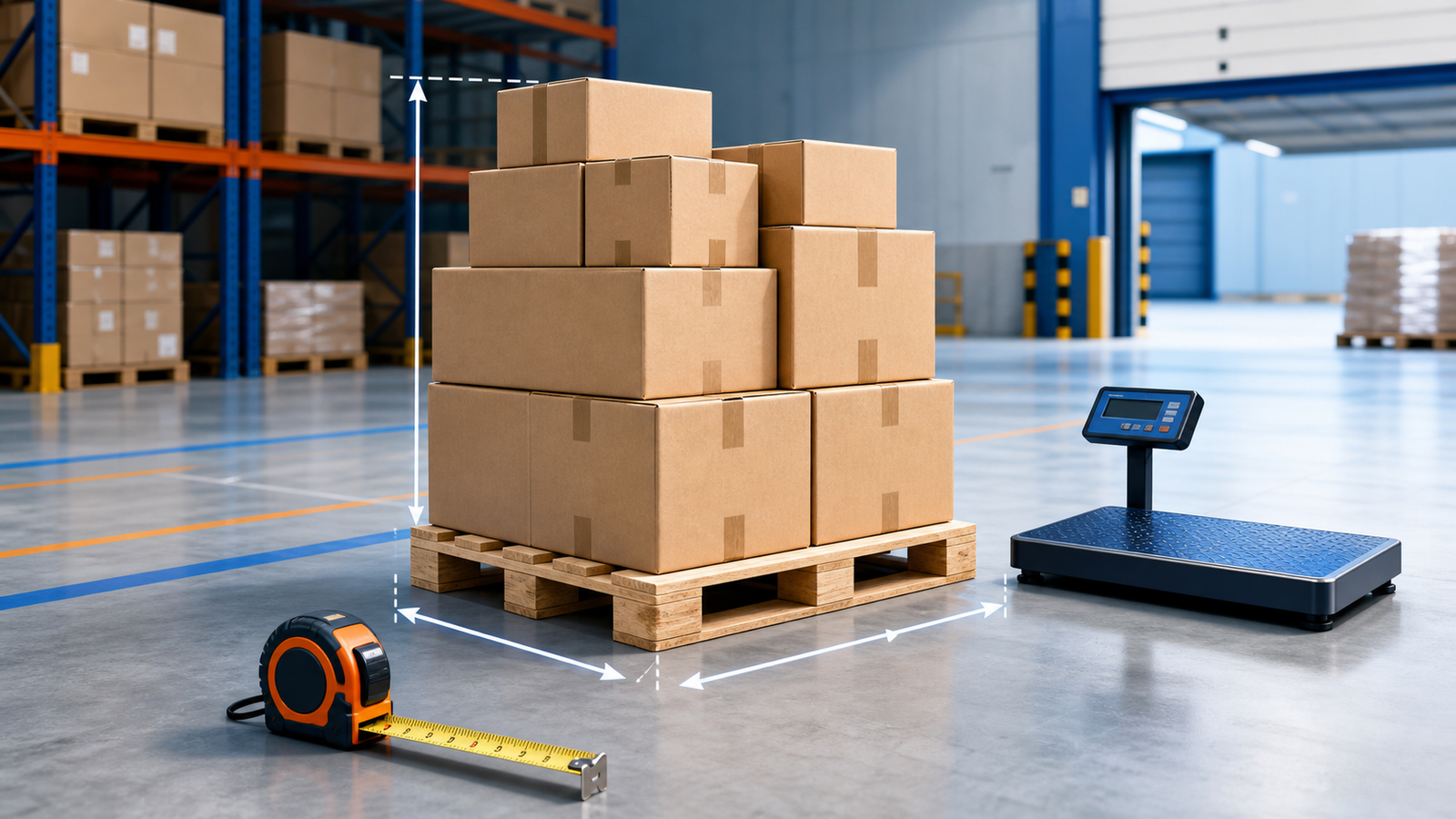
Enter packaged dimensions, weight, and quantity to estimate density, cubic feet, total weight, and freight class.
Guide
Freight Class Calculator Guide
Use this guide to understand freight density, LTL freight class estimates, and why the final class on a bill of lading or carrier invoice can differ from a simple density calculation.
What is LTL Freight Class?
LTL freight class is a shipping classification used for less-than-truckload freight. The class helps carriers rate freight based on how much space it takes, how heavy it is, and how difficult or risky it may be to move.
A freight class calculator is most useful when you need a quick density-based estimate before quoting or booking a shipment. The estimate is not a substitute for the exact NMFC item assigned to a specific commodity.
How to Calculate Freight Density (PCF)
Freight density is measured in pounds per cubic foot, often shortened to PCF. To calculate it, measure the packaged freight exactly as it will ship, including the pallet or crate when those dimensions are part of the handling unit.
Total cubic inches = length x width x height x quantityUse inches for LTL density math.
Total cubic feet = total cubic inches / 1,728There are 1,728 cubic inches in one cubic foot.
Density (PCF) = total pounds / total cubic feetHigher density usually maps to a lower freight class.
The NMFC Density Chart Explained
The density-based freight class chart maps pounds per cubic foot to a class from 50 to 500. Dense freight commonly lands in a lower class, while light and bulky freight commonly lands in a higher class.
| Density range | Estimated class |
|---|---|
| Less than 1 PCF | Class 500 |
| 1 to 1.99 PCF | Class 400 |
| 2 to 2.99 PCF | Class 300 |
| 3 to 3.99 PCF | Class 250 |
| 4 to 4.99 PCF | Class 200 |
| 5 to 5.99 PCF | Class 175 |
| 6 to 6.99 PCF | Class 150 |
| 7 to 7.99 PCF | Class 125 |
| 8 to 8.99 PCF | Class 110 |
| 9 to 10.49 PCF | Class 100 |
| 10.5 to 11.99 PCF | Class 92.5 |
| 12 to 13.49 PCF | Class 85 |
| 13.5 to 14.99 PCF | Class 77.5 |
| 15 to 22.49 PCF | Class 70 |
| 22.5 to 29.99 PCF | Class 65 |
| 30 to 34.99 PCF | Class 60 |
| 35 to 49.99 PCF | Class 55 |
| 50+ PCF | Class 50 |
How to Use This Calculator for Multiple Pallets
- If every pallet or box has the same dimensions and weight, enter the dimensions for one unit.
- Enter the weight per unit, not the combined shipment weight.
- Set quantity to the total number of matching pallets or boxes.
- The calculator multiplies both volume and weight by quantity before calculating density.
- If pallets are different sizes or weights, calculate each handling unit separately.
- For mixed freight, use totals that accurately represent the entire shipment before quoting.
Density vs. Exact NMFC Codes (Stowability, Handling, and Liability)
Density is important, but it is not the only factor in official NMFC classification. Exact NMFC codes can also consider stowability, handling, and liability. A fragile item, irregular shape, hazardous material, or difficult handling requirement may rate differently than density alone suggests.
Use this freight density calculator as a practical estimate, then confirm the correct class with your carrier, broker, tariff, or NMFC reference when the shipment has cost or compliance consequences.
FAQ
Freight Class Calculator FAQs
Quick answers about NMFC class, PCF density, carrier reclassing, and packaging.
What is NMFC?
NMFC stands for National Motor Freight Classification. It is the classification system used for many LTL shipments, with class affected by density and other shipment characteristics.
How do I calculate pounds per cubic foot (PCF)?
Divide the total shipment weight in pounds by the total cubic feet. Cubic feet equals length x width x height in inches divided by 1,728, multiplied by the number of units.
Why did my freight class change after it was measured by the carrier?
A carrier may remeasure dimensions, reweigh the freight, include packaging or pallet height, or apply an exact NMFC item that accounts for handling, stowability, or liability.
Is Class 50 or Class 500 more expensive to ship?
Class 500 is generally more expensive than Class 50 because it usually represents lower-density freight that takes more trailer space per pound.
Does packaging affect my freight class?
Yes. Packaging can change the measured dimensions, weight, handling needs, and sometimes the applicable NMFC item. Measure the shipment as it will actually be tendered.