Assumptions

Chemistry calculator
Use the Stoichiometry Calculator to solve reaction stoichiometry, limiting reagent, leftovers, gas and solution stoichiometry, and yield problems with clear step-by-step results.
Enter your values and click Calculate to see the result.
Primary Result
The breakdown follows the same stoichiometric path you would use on paper, but keeps the chemistry readable.
Each reactant is converted to moles and compared against its stoichiometric coefficient.
Excess reactants remain after the limiting reagent is fully consumed.
This calculator uses balanced-equation stoichiometry and a school-level formula parser. Unsupported chemical notation is intentionally rejected rather than guessed.
Calculator overview
Use this stoichiometry calculator to solve mole-to-mole, mass-to-mass, limiting reactant, solution, gas, and percent yield problems. The calculator keeps balanced-equation ratios visible so you can follow how reactants and products connect.
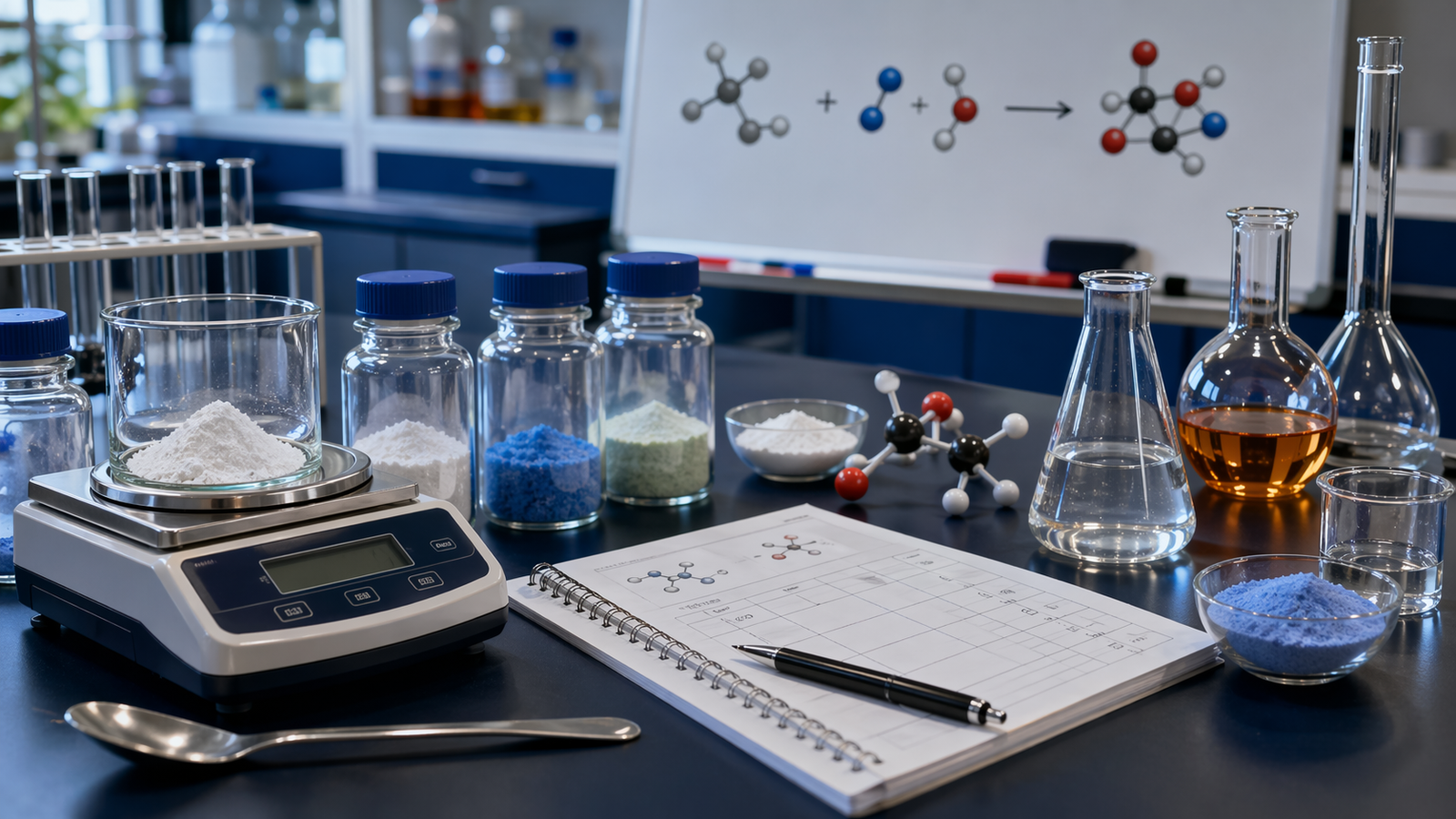
Enter the balanced reaction and known quantities to calculate stoichiometric amounts, limiting reagent, or yield with steps.
Guide
This guide keeps the chemistry practical. The goal is to help you move from a balanced reaction to a usable numerical answer without padding the page with theory you do not need in the middle of a problem.
This stoichiometry calculator solves the common quantitative reaction problems students and lab users run into most often: reactant-to-product conversion, mass-to-mass stoichiometry, mole-to-mole comparison, limiting reagent calculations, excess reactant leftovers, solution stoichiometry, gas stoichiometry at STP, and theoretical or percent yield.
It starts from a balanced chemical equation, converts the known quantity into moles, applies the stoichiometric ratio from the coefficients, and then converts the target amount into the requested unit. When limiting reagent mode is used, it compares every reactant against its coefficient so the maximum possible product amount stays chemically honest.
Stoichiometric calculations all follow the same basic path, even when the starting quantity is given as mass, molarity and volume, or gas volume at STP.
balanced equation -> convert to moles -> apply mole ratio -> convert to target unit The mole ratio comes directly from the balanced-equation coefficients. That is why a reaction must be balanced before the calculator will run. If the coefficients are wrong, every conversion after that point is wrong too.
The limiting reagent is the reactant that can support the smallest amount of reaction once every input is converted to moles and compared against its stoichiometric coefficient. That reactant runs out first, so it sets the maximum theoretical yield.
Any other reactants present beyond that required amount become excess reactants. The calculator reports those leftovers after the limiting reagent is consumed so the result feels like a real reactants-products-leftovers workflow, not just a single product number.
Type a school-level balanced chemical equation such as 2H2 + O2 -> 2H2O. The calculator validates the atom counts before it allows any stoichiometric math.
Select conversion, limiting reagent, solution stoichiometry, gas stoichiometry, or yield depending on the chemistry question you are solving.
Choose the given substance and target substance, or choose the target product when the mode is about limiting reagent or yield.
Use grams or moles for standard stoichiometry, molarity and volume for solution mode, and moles or liters at STP for gas mode.
The result panel appears with the solved quantity, supporting metrics, balanced equation summary, and a concise worked solution.
Here is a simple limiting-reagent example using the balanced reaction 2H2 + O2 -> 2H2O with 10.0 g of H2 and 32.0 g of O2. The oxygen supply limits the reaction, so it controls the maximum amount of water that can form.
Example theoretical yield
36.032252 g Water is limited by oxygen in this setup, and 5.967748 g of H2 is left over.This is the same logic the calculator uses in limiting reagent mode: convert all reactants to moles, compare reaction extent, identify the smallest value, and then calculate product and leftovers from there.
Use molar mass to move between grams and moles before or after applying the balanced-equation ratio.
When the known value is already in moles, the calculation becomes a direct coefficient ratio problem.
Convert molarity and volume into moles first, then continue with the standard stoichiometric workflow.
Use gas moles directly or convert liters at STP into moles when the problem is framed in standard-volume terms.
The calculator validates atom counts before it runs any stoichiometric math, because coefficient errors break every ratio that follows.
Mass, moles, solution volume, and gas volume all need the correct conversion path before the mole ratio is applied.
Mass-based stoichiometry depends on formula parsing and molar mass, so malformed formulas are rejected instead of guessed.
The smallest reaction extent sets the maximum possible product amount, and everything else is excess or leftover reactant.
Actual yield only makes sense after theoretical yield is known, which is why yield mode calculates theory first and percent yield second.
FAQ
Quick answers about stoichiometry, balanced equations, limiting reagent, leftovers, solution work, and gas assumptions.
Stoichiometry is the part of chemistry that uses a balanced equation to compare reactants and products quantitatively. It lets you move from moles to mass, from mass to mass, and from reactants to theoretical product amounts.
The stoichiometric coefficients in a balanced equation create the mole ratios used in every calculation. If the atoms do not balance, the ratio is wrong and the quantitative result will be misleading.
Convert the given mass to moles using molar mass, apply the balanced-equation mole ratio, and then convert the target moles back to grams. The conversion mode on this page follows exactly that workflow.
The limiting reagent is the reactant that runs out first when the reaction proceeds according to the balanced equation. It controls the maximum possible product amount, which is why it determines theoretical yield.
Yes. Limiting reagent mode compares all entered reactants, identifies the limiting one, and then shows the excess reactants left after the limiting reagent is consumed.
Yes. Solution mode converts molarity and volume into moles first, then uses the balanced-equation mole ratio to solve for the target substance.
Yes. Gas mode supports gas moles directly and gas volume at STP. When STP is used, the calculator makes that assumption explicit in the result.
Search MultiCalculators
Search calculators, categories, and helpful site pages.
Popular calculators and categories
No matching calculators found. Try a broader term or browse by category.